The Hair Loss Arms Race Is Real
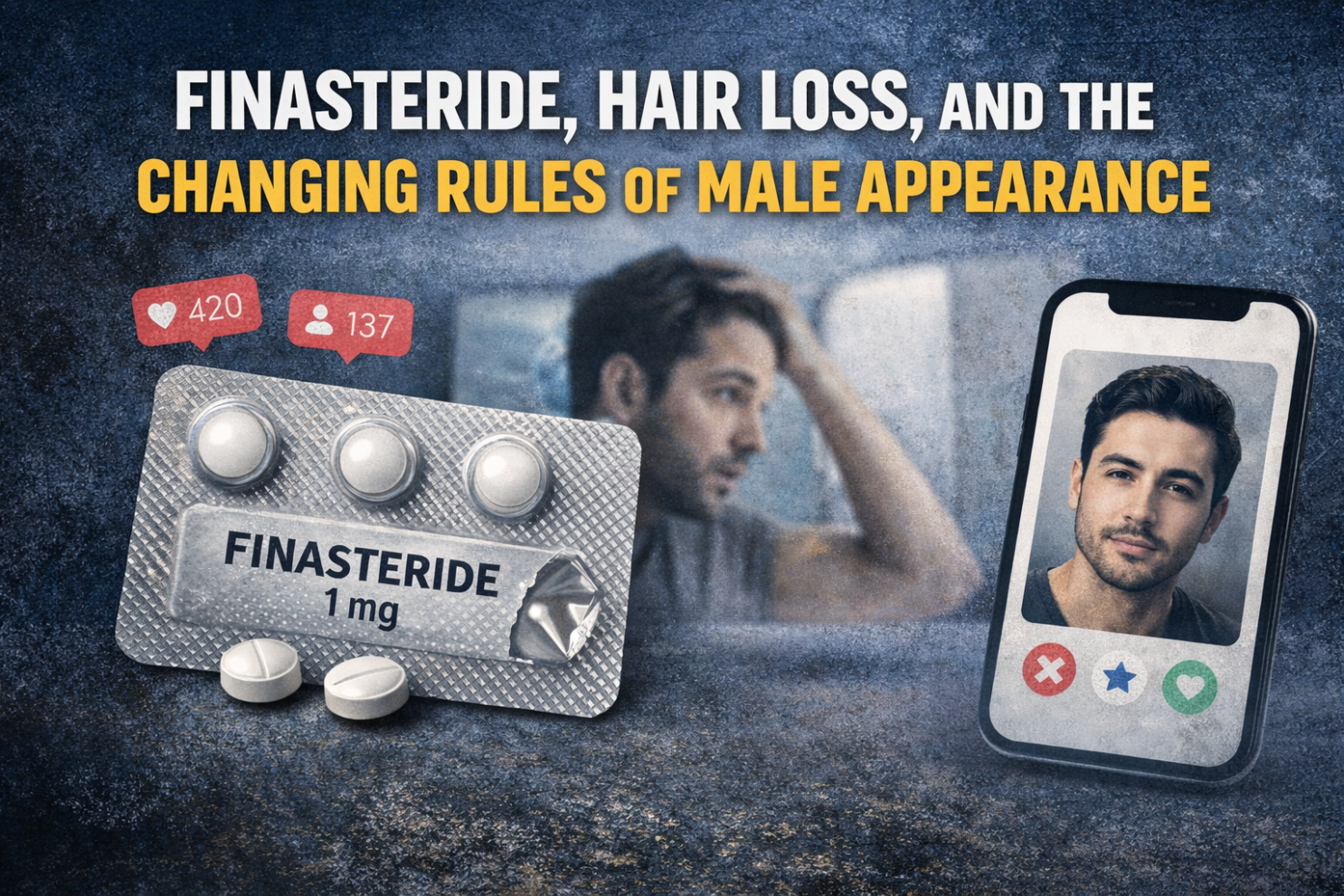
The New York Times recently published a thoughtful piece on finasteride and male hair loss that is less about the drug itself and more about something larger: the changing psychology of appearance.
It’s a useful shift in framing.
Because the real story is not that finasteride works. That has been established for decades. The real story is what happens after a solution becomes widely available, cheap, and socially visible.
The article follows a familiar arc. A young man becomes aware of his hair loss not in isolation, but through comparison. Group chats, photos, and casual conversations turn something gradual and almost invisible into something immediate and measurable. What might have once been ignored becomes something to track, discuss, and eventually act on.
That dynamic matters more than the drug.
Finasteride enters the picture as a tool, not a cause. It is effective. It is accessible. It lowers DHT and slows or stops hair loss in most men. Side effects exist, as they do with any drug that has a real biological effect, but they are relatively uncommon and typically resolve.
The article acknowledges all of this. Where it becomes more interesting is in what it suggests without fully developing.
It describes what one subject calls a “nuclear arms race,” where men begin to feel that opting out is no longer neutral. If enough people act, the baseline shifts. What used to be normal starts to look like falling behind.
This is not unique to hair.
It is the same pattern seen in other domains of appearance. Once a subset of people adopts an intervention that produces visible results, the social standard recalibrates. The intervention moves from optional to expected, even if no one explicitly says so.
What the article is circling is a broader transition.
For decades, women have operated within a system of continuous aesthetic optimization. Skin care routines, cosmetic procedures, hair treatments, and subtle medical interventions have all contributed to a shifting baseline of what is considered “normal.” These behaviors are rarely framed as alarming. They are treated as routine, even responsible.
Men are now entering a similar system, and it looks unfamiliar enough to draw attention.
The anxiety described in the article is real. So is the increased scrutiny. Social media, dating apps, and constant photographic exposure have made appearance more legible and more comparable than at any point in the past. It is not surprising that people respond to that environment by trying to exert some control over it.
The question is whether that response is pathological or simply adaptive.
The article leans toward interpreting it as a source of distress. It highlights the obsessive checking, the forum debates, and the uncertainty around side effects. All of that exists. But it is only part of the picture.
What it does not fully explore is that for many men, the outcome is straightforward. They take a medication, maintain their hair, and move on. The decision becomes background noise rather than a defining psychological burden.
That outcome is less visible, but it is likely more common.
There is also a tension in how we evaluate the legitimacy of the decision itself. Treating hair loss is often framed as cosmetic, and therefore optional in a way that invites skepticism. But most medical decisions exist on a spectrum between necessity and preference. Improving quality of life, confidence, and social functioning has always been a valid reason to intervene.
The presence of a trade-off does not invalidate the choice. It defines it.
The most useful contribution of the article is that it surfaces a real shift. Hair loss is no longer something men are expected to accept without question. It is something they can act on. That change introduces new forms of pressure, but it also introduces new forms of agency.
Those two things tend to arrive together.
If there is a critique to be made, it is not of the drug itself, and not even of the people who choose to use it. It is of the environment in which every small change becomes visible, comparable, and open to judgment. In that environment, doing nothing is no longer invisible. It becomes a choice that carries its own consequences.
Finasteride did not create that environment. It simply fits into it.
And once a tool exists that reliably produces a desired outcome, it is not surprising that people use it.
The more difficult question is whether we are prepared for what happens next, when the baseline shifts again and what once felt like an advantage becomes the new normal.
That is not a medical problem.
It is a cultural one.
And it is not going away.
It’s a familiar formula. Take a widely used drug. Highlight a small set of adverse outcomes. Remove context. Add ambiguity. Let the reader sit in it.
Now it’s a story.
But strip away the tone, and what you’re left with is far less dramatic than what’s being implied.
Finasteride is widely prescribed because, by the standards that actually matter in medicine, it is considered relatively safe and effective. That conclusion is not coming from influencers, telehealth startups, or Reddit threads. It comes from randomized controlled trials, long-term follow-up data, and decades of clinical use.
The drug lowers DHT. That is the mechanism. That is also the point.
And like any drug that does something real, it has side effects.
This is where the article leans heavily into suggestion over proportion. Sexual side effects are typically reported in the range of about 2 to 4 percent in clinical trials. Not zero. Not nonexistent. But also not unusual.
Only it feels unusual when it’s presented in isolation.
Because once you introduce context, the entire tone collapses.
SSRIs, some of the most commonly prescribed medications in the country, carry sexual side effect rates that routinely exceed 25 percent and can go significantly higher depending on how they are measured. Statins, taken by tens of millions of people, are associated with muscle symptoms in a meaningful percentage of users in real-world data. Beta blockers can impair sexual function. Oral contraceptives alter hormone profiles and are well known to affect mood and libido.
These drugs are not treated as cultural flashpoints. They are treated as tools.
Why?
Because we understand that medicine is not a search for purity. It is a process of tradeoffs.
Every effective drug changes something in the body. That is not a flaw in the system. That is the system working.
Finasteride is no different. It alters hormone levels in a targeted way to prevent follicle miniaturization. If someone finds that tradeoff unacceptable, the correct conclusion is not that the drug is dangerous. The correct conclusion is that it is not the right choice for that individual.
What the article gestures toward, but does not resolve, is the idea of persistent or poorly understood side effects, often grouped under the label “post-finasteride syndrome.”
This is where things become less clear, and where the tone of the piece does the most work.
The evidence here is inconsistent. Some studies suggest a signal. Others fail to establish causation. Large, well-controlled datasets do not support the idea of a common, predictable syndrome affecting a significant portion of users. That does not mean no one experiences lingering problems. It means the phenomenon is not well defined, not well quantified, and not well understood.
Those are important distinctions.
But “uncertain and rare” does not generate the same reaction as “possibly permanent.”
So the emphasis shifts.
A small number of negative experiences begin to feel representative, especially when they are amplified through online communities and then elevated into mainstream coverage. Meanwhile, the far more common outcome, which is uneventful use, disappears into the background.
No one writes a feature about the millions of people who took a medication and experienced exactly what the data predicted.
There is also an undercurrent in the article that deserves more scrutiny. The idea that finasteride is somehow suspect because it is used for a cosmetic purpose.
This is a strange line to draw.
We prescribe medications for quality-of-life improvements all the time. Anxiety, acne, erectile dysfunction, hormonal regulation, sleep. These are not life-threatening conditions, but they are treated seriously because they affect how people live. Hair loss falls into the same category. Dismissing it as trivial enough to invalidate treatment while simultaneously treating its treatment as risky is an inconsistent position.
The real question is not whether a drug has side effects. Every drug does.
The question is whether the magnitude and probability of those side effects justify the benefit.
For many patients, the answer is yes. For some, it is no. That is what informed consent is supposed to address.
What is not helpful is presenting a well-characterized drug as if it exists in a fog of hidden risk that has only recently come into focus.
It hasn’t.
Finasteride has been studied for decades. Its risks are documented. Its benefits are documented. Physicians discuss both. Patients decide.
That process is not broken.
What is changing is how risk is being framed.
Fear is engaging. Ambiguity keeps attention. A calm presentation of probabilities does not.
So instead of “here is the evidence and how to interpret it,” the reader gets something closer to “this might be more dangerous than you think,” supported by selective emphasis and unresolved questions.
It works. People read it. People share it. People feel something.
But feeling something is not the same as understanding something.
If the standard being implied is that medications should not be widely used unless their risks are perfectly understood and effectively nonexistent, then almost nothing qualifies. That is not a serious position. That is a rhetorical one.
Finasteride is not risk-free. No drug is.
But the evidence does not support the level of alarm being suggested.
What remains, once the framing is removed, is straightforward.
A drug with a clear mechanism.
A low but real rate of side effects.
An even smaller and less defined set of persistent complaints.
And millions of people using it without incident.
That is not a controversy.
It just doesn’t sell particularly well.